Biomass → Pyrolysis → Biochar. Soil Passport positions SPX BioChar™ not as another biochar certification, but as a global digital standard for measuring the agricultural value and traceability of biochar in soil — sitting above the farm-use layer and connecting biochar, soil, crop, water, carbon and farmer economics.
Every tonne of biochar should have a traceable journey from biomass source to soil application and measurable impact.
This complements existing biochar production and carbon-removal standards — such as production and quality-assurance frameworks and durable-carbon-removal methodologies — rather than trying to replace them. SP-BIS is the digital farm-to-soil impact layer built around that ecosystem.
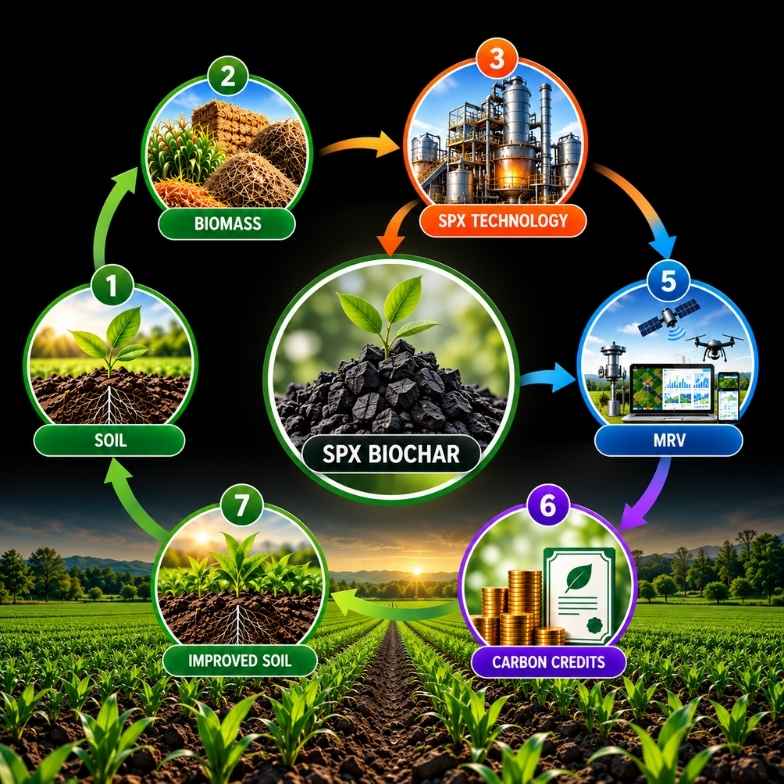
The carbon-removal calculation is designed to be compatible with recognised third-party methodologies rather than inventing an independent carbon-credit claim — consistent with how established carbon-removal methodologies require evidence on biomass sourcing, production and end use.
This is where the Soil Passport device, app and satellite intelligence become central.
Soil Passport does not promise a fixed improvement in water retention — the effect varies by biochar, soil and application conditions. Instead, the change is measured through the Soil Passport system.
Biochar cost, measured against potential savings and additional value — turning "biochar is good for soil" into a measured ₹/acre impact.
"Here is the measured economic and environmental impact of biochar on this farm" — replacing a general claim with a specific, field-level number.
The system can calculate the relevant carbon-removal quantity subject to the applicable carbon methodology and third-party verification. Soil Passport does not claim that its own measurement automatically creates a carbon credit — existing carbon standards require defined methodologies, independent verification and registry infrastructure, and SP-BIS is designed to work alongside them.
Batch → Farm → Application
Batch → Soil → Crop → Impact
Batch → Soil → Carbon Removal, with independent verification
This separation is strategically important: NZLoop is the implementation/operating business, while Soil Passport is the technology and standards platform.
SPX BioChar™ is Soil Passport's biochar product pathway — agricultural biomass converted through pyrolysis into a stable, carbon-rich material for soil amendment and long-term carbon removal, tracked under the Soil Passport™ Biochar Impact Standard (SP-BIS).
Crop residue, husk, stalks and other agricultural biomass are the primary feedstocks, processed through slow or fast pyrolysis at roughly 350–700°C.
SP-BIS (Soil Passport™ Biochar Impact Standard) is a digital measurement framework covering biochar quality, soil health impact, water indicators, crop productivity, carbon, farmer economics and field-to-batch traceability — based on published thresholds and measurement protocols, not an arbitrary rating.
SP-BIS can calculate the relevant carbon-removal quantity subject to the applicable carbon methodology and third-party verification. We don't claim that our own measurement automatically creates a carbon credit — existing carbon standards require defined methodologies, independent verification and registry infrastructure, and SP-BIS is designed to work alongside them, not replace them.
Yes. SP-BIS complements existing biochar production and carbon-removal standards rather than trying to replace them — it's the digital farm-to-soil impact layer built around that ecosystem.
Yes — syngas and bio-oil generated during pyrolysis can be captured for energy use alongside the primary biochar output, depending on plant design.
SPX BioChar™ is listed on the Soil Passport™ Marketplace, or you can apply as a Plant & Project Partner to produce it under SP-BIS in your own region.
 Soil Passport™